Master’s degree thesis in Condensed Matter Physics, Theoretical and Computational Physics curriculum at the University of Trieste, supervised by Prof. Daniele Coslovich and defended in March 2026.
The official University of Trieste page for this thesis is available here.
Abstract
Water is one of the most abundant substances on Earth, and it shapes an extremely wide range of natural phenomena, including life itself. Unlike most molecular liquids, it shows pronounced thermodynamic anomalies already near ambient conditions. The best known example is the density maximum near 4°C, but many other thermodynamic properties follow unusual temperature and pressure trends. These features, together with water’s rich phase behavior, have motivated decades of work aimed at building models that connect molecular structure to macroscopic observations.
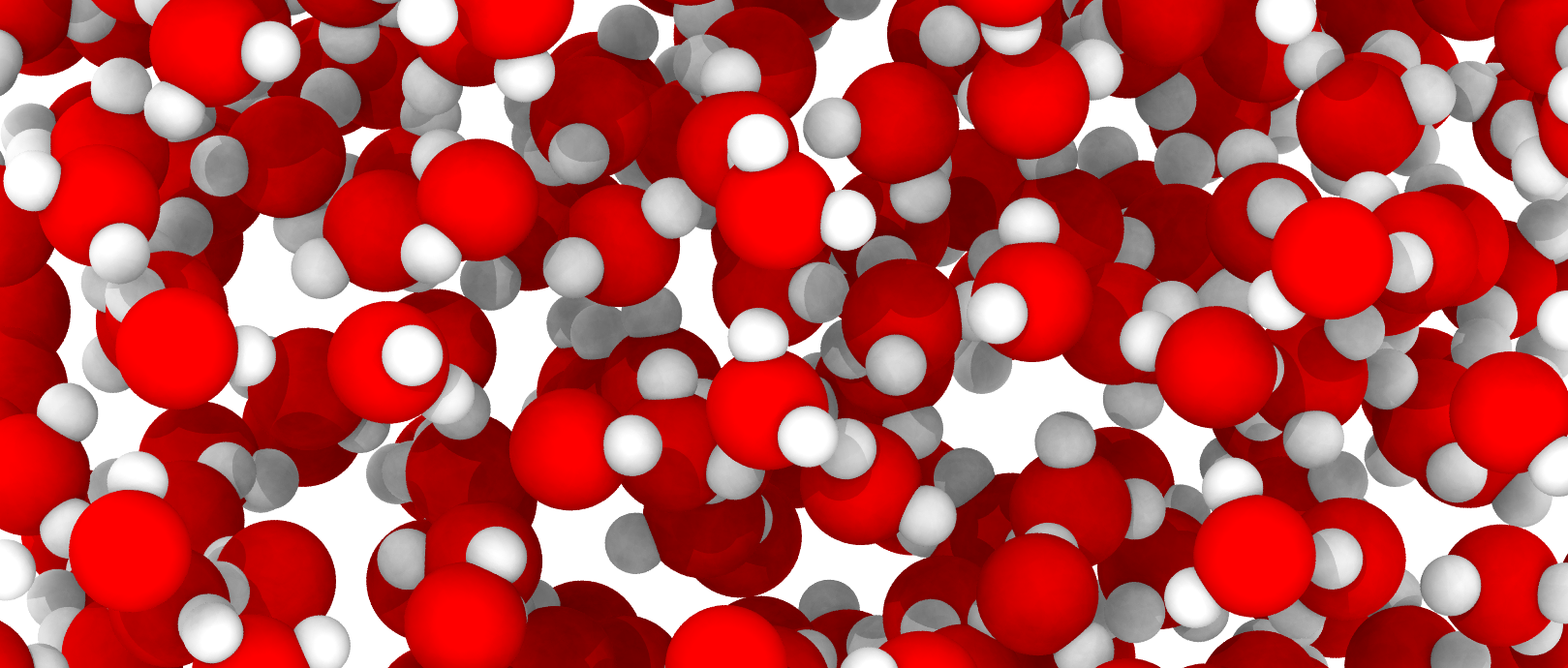
In this thesis we use classical molecular dynamics simulations of the TIP4P/2005 model to investigate water across a broad set of temperatures and pressures, including the supercooled regime where experiments are increasingly limited by crystallization. We first quantify how selected structural and thermodynamic observables evolve across the investigated state points, and we then analyze how transport and relaxation change upon cooling.
As temperature decreases, liquid dynamics slow down. If the relaxation time becomes longer than the accessible observation time, the system effectively falls out of equilibrium and a glass is obtained. In water, indications of glassy slowing-down emerge already in the stable liquid above the melting temperature. A main focus of the thesis is to determine how the onset of glassiness relates to the melting line, and whether the two follow each other as pressure is varied.
A second aim of this work is to critically test the two-state description of liquid water. In this framework, the liquid is treated as a mixture of locally tetrahedral and more close-packed environments, with a relative fraction that changes with thermodynamic conditions. Starting from this hypotesis, we check whether this picture can account consistently for the anomalies observed in TIP4P/2005 water.
Bibliography
Some of the papers on which this work is based are
- Daniele Coslovich, Leonardo Galliano, and Lorenzo Costigliola. “Freezing, melting and the onset of glassiness in binary mixtures”. In: The Journal of Chemical Physics 162.6 (Feb. 2025). arXiv:2406.04921 [cond-mat], p. 061102. issn: 0021-9606, 1089-7690. doi: 10.1063/5.0252877. url: http://arxiv.org/abs/2406.04921.
- John Russo and Hajime Tanaka. “Understanding water’s anomalies with locally favoured structures”. en. In: Nature Communications 5.1 (Apr. 2014), p. 3556. issn: 2041-1723. doi: 10.1038/ncomms4556. url: https://www.nature.com/articles/ncomms4556.
- J. L. F. Abascal and C. Vega. “A general purpose model for the condensed phases of water: TIP4P/2005”. en. In: The Journal of Chemical Physics 123.23 (Dec. 2005), p. 234505. issn: 0021-9606, 1089-7690. doi: 10.1063/1.2121687. url: https://pubs.aip.org/jcp/article/123/23/234505/965459/A-general-purpose-model-for-the-condensed-phases.
- Paola Gallo et al. “Water: A Tale of Two Liquids”. In: Chemical Reviews 116.13 (July 2016), pp. 7463–7500. issn: 0009-2665. doi: 10.1021/acs. chemrev.5b00750. url: https://doi.org/10.1021/acs.chemrev.5b00750.